

LMQL
Modular programming for LLM interaction
LMQL is a powerful programming language designed for seamless interaction with large language models, offering robust prompting and modularization capabilities for developers.
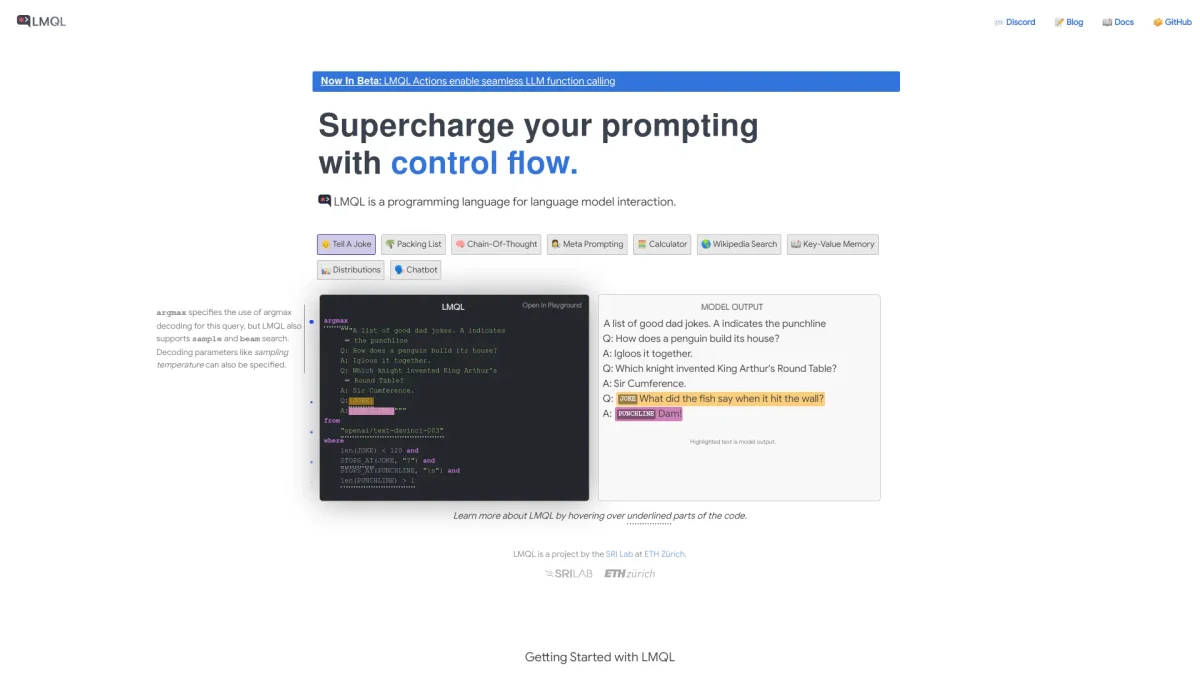
What is LMQL?
LMQL is a programming language specifically designed for interacting with large language models (LLMs). Its primary purpose is to provide a robust framework for modular and optimized prompting, addressing the complexity of LLM interactions. By utilizing types, templates, and constraints, LMQL simplifies the process of generating precise and context-aware outputs, making it easier for developers to create sophisticated applications that leverage the capabilities of LLMs. The key benefits of LMQL include its ability to enhance portability across various backends with minimal effort, making code reuse and sharing straightforward. Additionally, its support for nested queries allows for more organized and efficient prompt construction. By using LMQL, developers can maximize the potential of LLMs while reducing the time and effort required to implement complex prompts, leading to increased productivity and improved user experiences in applications such as chatbots, data processing, and more.
Key Features
- Modular LLM prompting capabilities
- Support for nested queries
- Portable code across multiple backends
- Typed variables for guaranteed output format
- Constrained generation with runtime optimization
- Integration with Python for seamless usage
Who is it for?
- Software developers and engineers
- AI researchers and enthusiasts
- Data scientists working with LLMs
- Tech startups leveraging AI
- Educational institutions teaching AI concepts
Use Cases
1. Building Intelligent Chatbots
Leverage LMQL to create sophisticated chatbots that can understand and respond to user queries with contextual awareness. The modularity allows for easy updates and enhancements to the bot's capabilities.
2. Data Processing Applications
Utilize LMQL's optimized prompting to streamline data processing tasks, enabling quick data retrieval and analysis through LLM interactions, making it ideal for research and analytics projects.
3. Interactive Learning Tools
Develop interactive educational applications that utilize LLMs to provide tailored learning experiences. LMQL's features allow for dynamic content generation based on user input.
Pricing Plans
Pricing information not available on website. Please visit the official website for current pricing.
Frequently Asked Questions
1. What programming paradigms does LMQL support?
LMQL supports procedural programming through its modularized query structure, allowing developers to create complex prompts using functions with nested queries and constraints.
2. Can I use LMQL with different LLM backends?
Yes, LMQL is designed to be portable across various LLM backends, allowing developers to switch between them with a single line of code, enhancing flexibility in application development.
3. Is there a community for LMQL users?
Absolutely! LMQL has a dedicated community on Discord where users can share experiences, seek help, and collaborate on projects. It's a great way to connect with other developers.
4. How does LMQL handle output formatting?
LMQL utilizes typed variables to ensure guaranteed output formats, allowing developers to specify constraints and types for the generated data, which helps in maintaining consistency.
LMQL Reviews & Ratings
Real user feedback and ratings for LMQL. See what the community thinks about this AI tool.
No reviews yet
Be the first to share your experience with LMQL