

Open Voice OS
Community-driven open-source voice AI platform
Open Voice OS is a versatile voice AI platform for creating custom voice-controlled interfaces with a focus on privacy, security, and community collaboration.
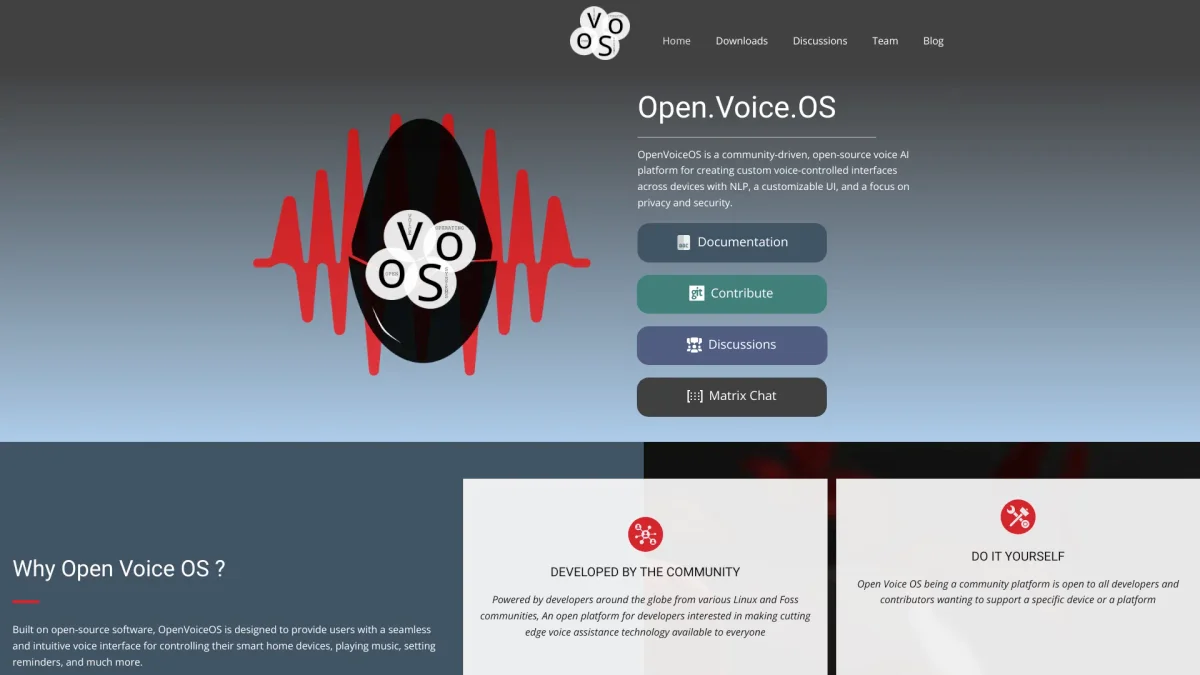
What is Open Voice OS?
Open Voice OS is a community-driven, open-source voice AI platform that allows developers to create custom voice-controlled interfaces across various devices. Its main purpose is to democratize voice assistance technology, making it accessible and adaptable for everyone. By providing a robust framework with natural language processing (NLP) capabilities, Open Voice OS addresses the need for personalized and privacy-focused voice interactions in a rapidly evolving tech landscape. The platform supports multiple hardware configurations, including Raspberry Pi and Linux systems, enabling users to design their own smart speakers or voice assistants. Open Voice OS empowers developers with a customizable UI and a plugin-based architecture for speech recognition and text-to-speech functionalities. Users can extend the platform's capabilities through community-developed skills, making it an ideal solution for DIY enthusiasts, developers, and anyone looking to enhance their technological environment with voice AI.
Key Features
- Community-driven development
- Supports various hardware platforms
- Customizable user interface
- Privacy-focused architecture
- Plugin-based speech recognition and TTS
- DIY smart speaker capability
- Open-source and free to use
Who is it for?
- Developers and programmers
- DIY electronics enthusiasts
- Linux users and communities
- Smart home technology advocates
- Voice technology researchers
Use Cases
1. Build Your Own Smart Speaker
With Open Voice OS, users can create custom smart speakers using Raspberry Pi or similar devices. This allows for personalized voice interaction and control over smart home devices, tailoring the experience to individual needs.
2. Develop Custom Voice Skills
Developers can leverage Open Voice OS to create and enhance voice skills for various applications. This flexibility enables tailored solutions for specific user requirements, promoting innovation in voice technology.
3. Experiment with Voice AI Technology
Open Voice OS serves as a playground for experimentation with voice AI features. Developers can test new functionalities and gather user feedback before integrating them into larger Linux-based projects.
4. Privacy-Focused Voice Assistant
Open Voice OS offers an offline mode for certain functionalities, allowing users to maintain privacy and security while enjoying voice assistance capabilities. This is ideal for users concerned about data privacy.
Pricing Plans
Free: Completely open-source and free to use, Pro: Pricing information not available on website, Enterprise: Custom pricing - Contact for tailored solutions.
Frequently Asked Questions
1. Is Open Voice OS free to use?
Yes, Open Voice OS is completely free and open-source. It's released under the Apache License 2.0, allowing for personal or commercial use, modification, and distribution.
2. What hardware does Open Voice OS support?
Open Voice OS can run on various hardware platforms, including Raspberry Pi models, Linux desktops, and Docker containers, making it highly versatile for different use cases.
3. Can I contribute to Open Voice OS?
Absolutely! Open Voice OS encourages community contributions, whether it's through testing, documentation, skill development, or code contributions. There's a place for everyone to get involved.
4. How does Open Voice OS compare to Mycroft?
Open Voice OS began as MycroftOS but has since evolved into an independent project. It maintains compatibility with Mycroft while adding extra functionality and focusing on community-driven development.
Open Voice OS Reviews & Ratings
Real user feedback and ratings for Open Voice OS. See what the community thinks about this AI tool.
No reviews yet
Be the first to share your experience with Open Voice OS